Why Are Entry-Level Jobs So Hard to Get in 2026?
Shantelle Dunlap · · 16 min read
Workforce Insights
Employment for 22- to 25-year-olds in the most AI-exposed jobs is now 19% below where it should be — not because anyone got laid off, but because the entry-level role was never created.
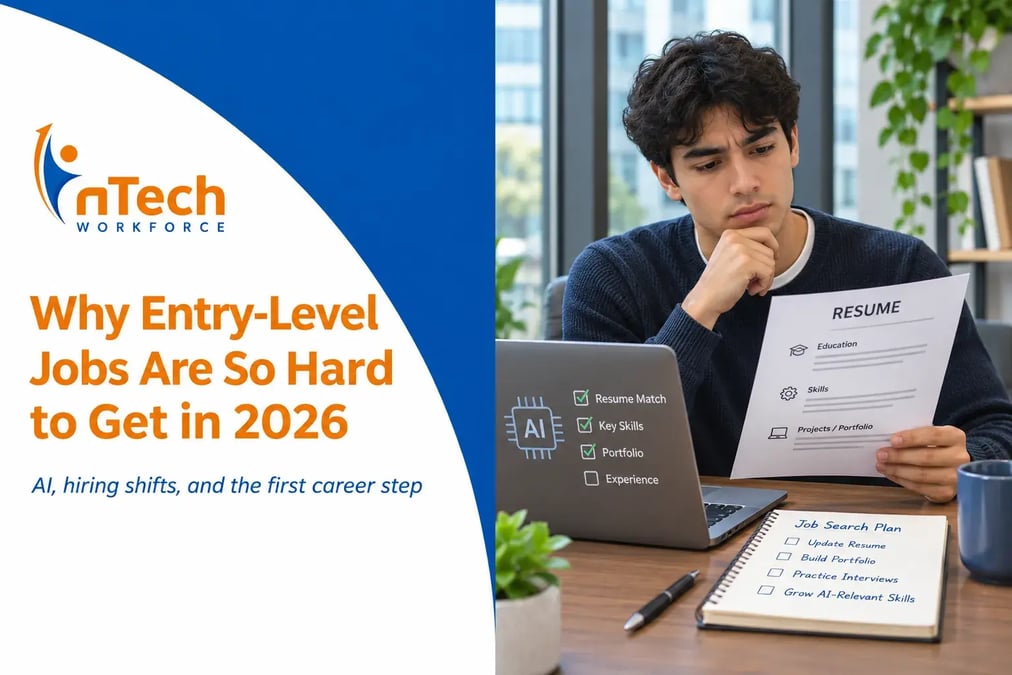
Someone graduates from college, applies for an entry-level job, and gets rejected because they don’t have enough experience.
But wasn’t an entry-level job supposed to be where they got that experience?
If you’ve been asking “Why can’t I find an entry-level job in 2026?”, that contradiction probably sounds familiar. The first step into a career seems to require skills that people used to learn after joining.
We recently looked at why low unemployment doesn’t necessarily mean finding a job is easy. That article explained the difference between having a job and having adequate work. This time, we’re looking at a more specific problem: why recent graduates and people entering a new field are finding it difficult to get their first professional role, and how artificial intelligence fits into the picture.
The answer isn’t simply that AI has taken all the junior jobs. Hiring has slowed, employers have raised some experience requirements, and AI is changing the work that used to be given to new employees.
The concern isn’t only that some entry-level work can now be automated. It’s that people still need a first job to learn the skills employers expect them to have.
Why Is Finding an Entry-Level Job So Hard Right Now?
Let’s start with the openings themselves.
An analysis of 7,984 salaried job postings from a consistent group of employers, using Cadient data, found that the share accepting people with no previous experience fell 73% between 2022 and 2026. In that sample, roughly one in 15 openings accepted candidates without experience in 2022. By 2026, it was about one in 50.
That is a striking change. But it is important to be precise: the study followed a particular group of employers. It does not mean 73% of all US entry-level jobs disappeared.
We see a similar problem in technology hiring. Indeed Hiring Lab found that the proportion of tech job postings requiring at least five years of experience rose from 37% to 42% between the second quarters of 2022 and 2025. During the broader tech hiring slowdown, standard and junior tech job postings also held up less well than senior roles.
Meanwhile, the Federal Reserve Bank of New York reported 5.2% unemployment among recent college graduates in the third quarter of 2026. It also reported 42.5% underemployment, meaning employed graduates working in occupations that typically do not require a bachelor’s degree.
That gives us two separate problems. Some graduates cannot find work. Others have work, but not in jobs that typically need the qualification they spent years earning.
| Metric | Then | Now |
|---|---|---|
| Salaried openings accepting zero prior experience (Cadient, 2022–2026) | ~1 in 15 | ~1 in 50 |
| Tech postings requiring 5+ years of experience (Indeed Hiring Lab, Q2 2022–Q2 2025) | 37% | 42% |
| Entry-level postings requiring AI skills (NACE, fall 2025–spring 2026) | ~13% | 35%+ |
And yet the situation isn’t identical everywhere. The National Association of Colleges and Employers (NACE) projected a 5.6% increase in hiring for the Class of 2026 among its surveyed employers. So it would be misleading to say every employer has stopped hiring graduates.
What has become harder is finding the right opening, especially one that genuinely accepts someone who is still learning.
Is AI Really Replacing Entry-Level Jobs?
There is evidence that AI is affecting junior hiring, but not in the simple way many headlines suggest.
Researchers Erik Brynjolfsson, Bharat Chandar, and Ruyu Chen at Stanford studied payroll records covering millions of US workers. In the August 2026 revision of their paper, Canaries in the Coal Mine?, they reported that employment among 22-to-25-year-olds in highly AI-exposed occupations was 19% below where it would have been had it grown at the rate of less-exposed peers.
There was no comparable gap among more experienced workers in those same occupations.
The study found that the difference was mainly associated with less hiring of younger workers, rather than employers suddenly firing large numbers of them. It was also more pronounced where AI could substitute for tasks rather than support people performing them.
But Stanford’s researchers were careful about what they could conclude. They described their findings as early evidence of a possible AI effect, not proof that AI caused the entire 19% difference. Broader hiring conditions, education, and differences in the dataset still matter.
The Federal Reserve Bank of Dallas added another piece of evidence in September 2026. Looking at job-advertising data, its economists found that employers were posting fewer vacancies for occupations with tasks that generative AI can automate. Among Texas employers in the analysis, the estimated overall effect on online job postings was modest, but more exposed jobs experienced larger declines. Research like this helps explain why the effect can be concentrated even when economy-wide employment looks fairly stable.
Think about a marketing team. A few years ago, a junior analyst might have spent much of the week collecting competitors’ prices, preparing an initial report, and making slides. Today, an experienced analyst can use AI to speed up some of those tasks.
The team still needs someone to check the results, understand what the numbers mean, and make a recommendation. But it may need fewer people whose main responsibility is preparing the first draft.
AI doesn’t have to replace an entire job to reduce the amount of beginner work available.
That doesn’t mean all companies are deliberately cutting junior positions because of AI. In NACE’s late-2025 employer survey, 61% said they would not replace entry-level jobs with AI. Its spring 2026 update also found that only about 11% were discussing using AI to replace some positions. Those are survey responses, not a complete count of hiring decisions, but they help keep the picture balanced.
Why Are Some White-Collar Jobs Facing More Pressure Than Skilled Trades?
The impact depends less on the job title and more on what work happens inside the job.
Work that involves writing first drafts, summarizing documents, basic coding, routine research, and preparing standard reports is more exposed to today’s generative AI than work that requires someone to physically install, repair, inspect, or operate equipment.
And the broader hiring numbers were already moving in different directions. Kelly Services reported that information, finance, and professional and business services lost an average of around 9,000 jobs a month from 2023 to 2025. Construction, transportation, and retail trade added about 12,000 a month over the same period. These are broad industry figures, not direct measurements of AI-related job losses.
PwC’s 2026 Global AI Jobs Barometer offers an especially useful finding. From its study of more than a billion job advertisements, PwC identified a change it called seniorisation: some entry-level jobs now ask for skills traditionally associated with experienced employees, such as judgment, leadership, and complex decision-making.
In its US entry-level analysis, openings with those elevated skill requirements increased 35% since 2019, while other entry-level roles in the comparison declined 10%.
That’s the part employers and graduates should pay attention to. The label on the vacancy may still say “entry-level,” but the work expected of the person has changed.
This does not mean blue-collar jobs are immune to AI. AI is already helping with planning, scheduling, diagnosis, documentation, and other tasks in physical industries. And different skilled trades have different demand patterns.
But a language model cannot walk into a building and replace a faulty electrical panel by itself. The physical and safety responsibilities make the exposure different from many desk-based tasks.
Is “Just Learn a Trade” Really the Safest Career Advice?
For some people, learning a trade is a good decision. But “jobs AI can’t replace” is not a complete career plan.
Take electricians. The BLS projects 9% employment growth from 2025 to 2035, faster than the overall occupational average. That suggests real demand.
But you don’t become a qualified electrician overnight. Many people enter through apprenticeships, and most states have licensing requirements. The job may also involve physical risk, irregular hours, and location-specific opportunities.
A person with a computer science degree in one city cannot assume there is an immediately available apprenticeship in the same city, or that they can afford years of training at a lower wage.
A trade may be less exposed to today’s generative AI without being easy to enter, easy on the body, or equally in demand everywhere.
The better question isn’t whether an occupation is labelled white-collar or blue-collar. It is: what skills are needed, what does the path into the role look like, what does the work pay, and how is demand changing in the local market?
What Is Skills-Based Hiring, and Why Does It Matter for Entry-Level Jobs?
Skills-based hiring means looking at what someone can actually do, rather than using a degree or years of experience as the only filter.
That might mean reviewing a portfolio, asking a candidate to solve a relevant problem, evaluating a certification, or discussing work completed through an internship or project.
NACE’s spring 2026 employer survey found that nearly 70% of respondents used some form of skills-based hiring. The same research found employers placing value on internships, co-ops, teamwork, communication, and problem-solving.
AI literacy is becoming part of that picture. More than one-third of employers in NACE’s spring update said AI skills were required in the entry-level jobs they were discussing, nearly triple the share reported in the previous fall survey. That is an employer survey finding, not a count showing that one-third of every entry-level posting in America requires AI. NACE’s findings also show employers are considering how AI changes tasks, not only whether it replaces positions.
Consider a graduate applying for a junior data analyst position. Saying “I know Excel and AI” doesn’t tell the hiring manager very much.
Showing a small project where they cleaned messy data, used AI to draft an analysis, checked its mistakes, and explained the final result tells a much better story.
The candidate has not pretended to have three years of employment experience. They have shown what they can already do.
A degree tells an employer what you studied. A useful work sample helps show how you approach the job.
There’s a responsibility on employers too. If every junior role requires the judgment of someone with five years of experience, the organization is no longer really offering a starting position. It is looking for an experienced hire at a junior title.
How Can You Get an Entry-Level Job When Every Job Wants Experience?
If you’ve been applying for entry-level jobs with no interviews, applying to another hundred openings may not be the most useful next step.
Start by checking whether you’re applying to positions that genuinely accept new entrants. The words junior, associate, and entry-level don’t always mean the same thing. Look at the actual work, the essential requirements, and whether the employer offers training.
Then give employers something concrete to evaluate:
- Show practical skills. Build one or two relevant projects, not a folder full of generic certificates. Include what you did, what tools you used, what went wrong, and how you checked the result.
- Explain how you use AI responsibly. If AI helped with a project, say which parts it helped with and what you personally verified or improved. Employers still need judgment and accountability.
- Use internships, apprenticeships, and project work where appropriate. They give you examples of actual work and people who can speak about your contribution.
- Look beyond permanent direct-hire vacancies. Suitable contract jobs and contract-to-hire roles can offer relevant experience, although neither automatically leads to permanent employment.
- Talk to recruiters who know your field. A specialist recruiter may be able to explain which requirements are genuinely essential, which skills are transferable, and whether an opening is active.
There’s also a useful way to think about AI-augmented jobs versus work that AI can automate. Look for roles where you use technology to help solve a business problem, check outputs, work with people, or make decisions. Don’t rely on a label alone; read what the role actually involves.
You don’t need to convince every employer that you can do everything. You need enough evidence to convince the right employer that you can contribute and learn.
What Should Employers Do Before Their Entry-Level Talent Pipeline Disappears?
This is the part of the conversation that gets less attention.
When a company removes the junior tasks from a role, it may improve productivity today. But if it also stops bringing new people into the team, where will the experienced employees come from in three or five years?
Someone has to learn the systems, understand the customers, make mistakes safely, and develop judgment. AI can help with parts of that process, but an employer still has to create the opportunity to learn.
That makes entry-level workforce planning a different problem from filling the next vacancy.
Instead of writing a job description that asks for every skill on the senior employee’s resume, companies can identify which skills are required on day one and which can be taught through supervised work. They can use realistic skills assessments, mentoring, and defined projects to measure progress.
The other problem is repeatedly starting every search from zero.
In a healthcare contingent-workforce case study, nTech Workforce helped a large health insurer use previous hiring history and known candidates to build a reusable talent pipeline for recurring positions. Across a program covering 3,000+ contingent workers, documented time-to-fill improved 17.9%.
That project was not a study of AI or junior hiring. The relevant lesson is the recruiting process: when demand repeats, the knowledge from previous hiring should help with the next hire.
We applied related thinking in an IT staffing engagement, where recurring needs in ServiceNow, cloud, DevOps, identity management, and cybersecurity were tracked as skill clusters rather than treated as entirely new searches each time.
And our clinical research staffing case study shows why matching someone to the assignment conditions, not just checking credentials, matters for retention. That program focused on experienced clinical research associates, not entry-level roles, but the principle applies to any thoughtful assessment of fit.
For employers worried about the AI impact on entry-level hiring, the answer isn’t to ignore AI or hire juniors who have nothing meaningful to do. It’s to redesign the starting role so that AI handles appropriate routine tasks while the employee still develops the experience and judgment the business will need later.
That’s where skills-based hiring, structured training, and an active talent pipeline need to work together.
Where nTech Workforce fits in
At nTech Workforce, we help employers think beyond a single vacancy and build hiring approaches around recurring skills and real assignment needs. If you’re reviewing how to hire and develop early-career talent, talk to our team.
The entry-level problem isn’t simply that there are no jobs. It’s that the work, the expectations, and the ways people enter a profession are changing at different speeds. For job seekers, that means finding better ways to show what you can do and where you can grow. For employers, it means making sure today’s efficiency gains don’t remove the opportunities people need to become tomorrow’s experienced workers.
What Are People Asking About AI and Entry-Level Hiring?
Is AI really taking entry-level jobs?
There is evidence of weaker hiring among young workers in some highly AI-exposed occupations. Stanford’s 2026 study identified a 19% relative employment gap for workers aged 22–25 in those fields. But the researchers did not establish that AI caused the whole gap, and they found no evidence of widespread economy-wide displacement. AI is one part of a bigger hiring story.
Why is it so hard for recent college graduates to find jobs in 2026?
Some employers are hiring more cautiously, early-career tech roles have tighter experience requirements, and routine junior tasks are changing. The New York Fed reported 5.2% unemployment and 42.5% underemployment among recent graduates in Q3 2026. Not all industries or employers have the same hiring pattern.
Why do entry-level jobs require two or three years of experience?
Sometimes employers use an entry-level title for a position that expects someone to contribute immediately, with limited training. In other cases, software, industry rules, or client requirements create genuine baseline skill needs. The title alone is not enough; check the duties and how much training the company provides.
Are blue-collar jobs safer from AI than office jobs?
Many physical trades have less direct exposure to generative AI than routine desk work, but they aren’t immune to technology or market changes. Apprenticeships, licensing, physical demands, and location still matter when choosing a career.
What skills do employers want from entry-level candidates now?
Employers increasingly value demonstrated skills, including problem-solving, teamwork, communication, relevant technical tools, and responsible AI use where the job calls for it. A work sample or internship example can make those abilities easier to assess than a list of keywords alone.
Can contract-to-hire help me get experience without a permanent job?
It can be one route, especially for project-based or temporary needs. But a contract-to-hire position is not a promise of permanent employment. Ask about the assignment, required skills, pay, end date, training, and whether conversion is genuinely planned.
How should employers prepare for AI without losing their junior talent pipeline?
Separate tasks AI can support from the experiences junior employees still need to develop. Define what can be learned on the job, create supervised projects, assess actual skills, and build a reusable entry-level talent pipeline for recurring needs.
More from nSider